

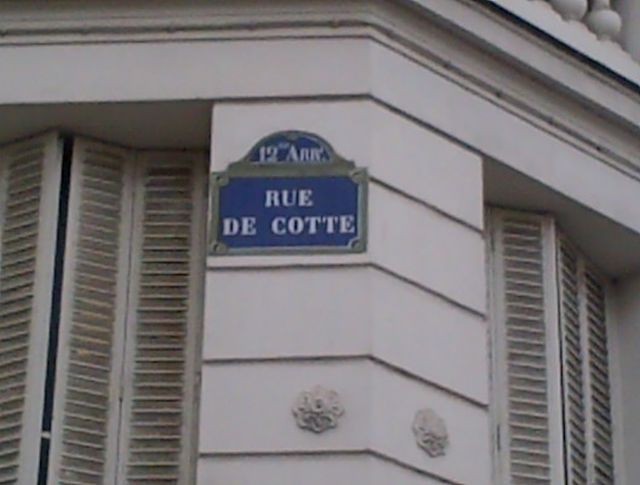
It’s well hidden in one of the old Faubourgs of Paris (on the rue de Cotte in the 12th arrondissement) where the first layers of an expanding city were added outside the city center in the 19th century during the epoch of industrialization. The place drew many poor people, where covered arches, markets, and galleries with fresh fruits, vegetables, and meats, and many other things one could randomly buy were traded, bartered, and sold at the time. As a result, many different artisans and craftsman decided to set up shop in the small stores lined across the narrow and crowded streets.
This quartier once known for poverty at the time has now, like so many streets in so many other big cities around the world, been gentrified when new money poured in over the past 25 years – during the financial revolution, so as to make a mark on the area and to introduce our own post-modern day epoch of high finance, hipsters, and luxury goods readily available for global consumption.
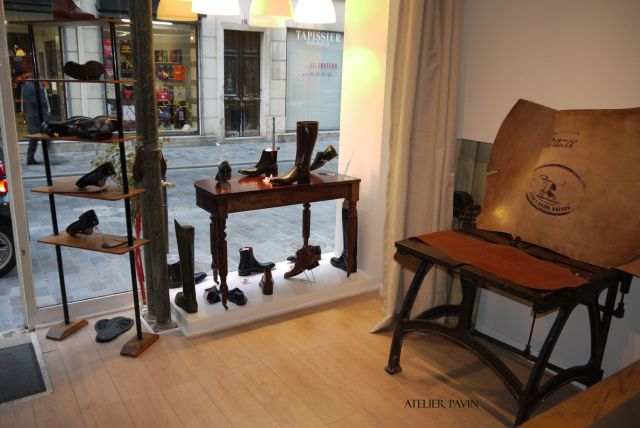
As the poverty has receded the first local Starbucks on the street corner may very well move in tomorrow, perhaps across from where is now located Cafe le Chat Bossu (the Hunchbacked Cat), at the end of what still remains a street full of pride of the old glory of ages past: Here you will find the old artisans & craftsman ateliers (workshops) of yore : The carpet maker, the picture frame maker, the maker of shoes, and many others! Here you can still find a master carpet maker, a master framer, and at Atelier Pavin, a full crew of master shoe makers, both for men as well as for women. The French language allows for the interesting difference between ‘Cordonnier ‘and ‘Bottier’, which would be the difference between shoemaker and bootmaker, but for the former only doing reparations – like a cobbler –, and the latter actually involved in the art of making shoes and boots. And thus, at Atelier Pavin, we have found one of the last remaining real shoemakers of our times!
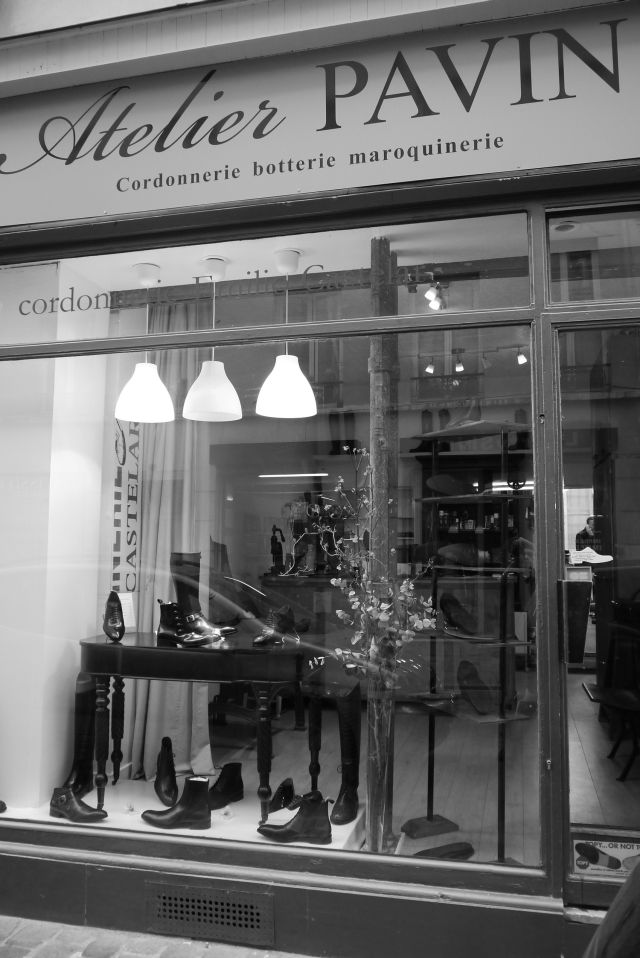
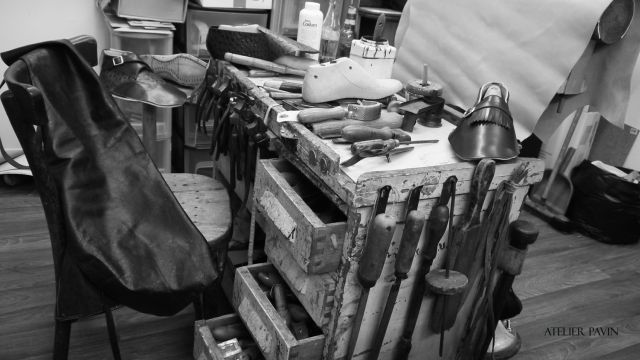
What a glorious grand art shoemaking is! Visiting the workshop we were given a thorough introduction into the high art and craft of making shoes and boots. Hundreds of workman’s tools were on display, and out of the necessary crew of eight different functions of people involved in the crafting (the word ‘manufacturing’ is out of place) of ONE pair of shoes or boots, three were present at the time. It can take up to 35 workman hours (a full work-week) to craft ONE pair of shoes, where as it can take up to 60 hours of craftsmanship for a pair of long boots. Prices range from between 250 and 450 euros for a pair of shoes SUR MESURE, to up to 1500 euros for your own MADE TO MEASURE pair of boots.
The craft man’s process is as follows: First there is a FORMIER who measures the foot and who makes a wooden shape of the foot according to the measurements taken. Secondly there is the EMBAUCHEUR who selects the materials to be used and who applies and measures the materials around the wooden shape. Then a PATRONIER – a real shoe designer, will draw the shoe or boot in all its form, style, and fashion on paper. You can witness the creative process of the art of high design first hand, as here is the part of the creative process where your boot or shoe is DESIGNED just for you — SUR MESURE, and according to your own measurements, your own style, your taste, your fashion…
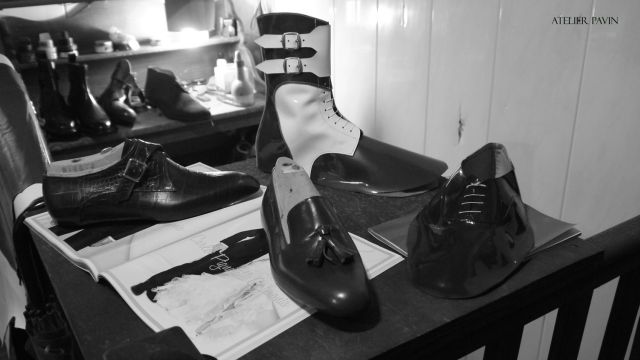
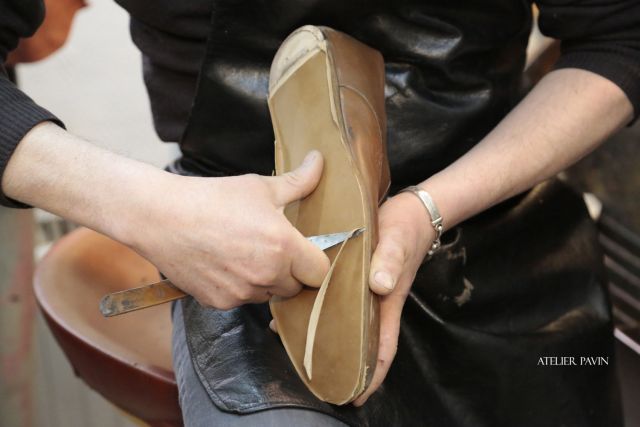
A COUPEUR will be cutting the materials (for men’s shoes mostly calf leather) and you will be halfway there when the MECANICIEN is introduced who will do the stitching but not the actual setting and the montage — because this work is left to the MONTEUR. Yet what is still not included is the setting of the heel and sole of the shoe. That part is left to the SEMELEUR, the sole and heel maker, a process done separately because of the difficulty and because of the importance of choosing and working the right materials. Mind you, to get it right, the sole and heel need to be worked and prepared in many different ways before they are actually put on the boot or shoe.
Thus we witness a highly complex, very creative, and labor-intensive process at Atelier Pavin, which of course is not complete without the perfect final touch: A good old shoe-shine by the all-but-forgotten and legendary tradesman, the BICHONEUR or CIREUR, the shiner of shoes. The shiner of shoes waxes & shines, prepares & packages the shoes & the boots and is also responsible for timely and impeccable delivery. Voila in a nutshell the grand old art of making real boots and real shoes.
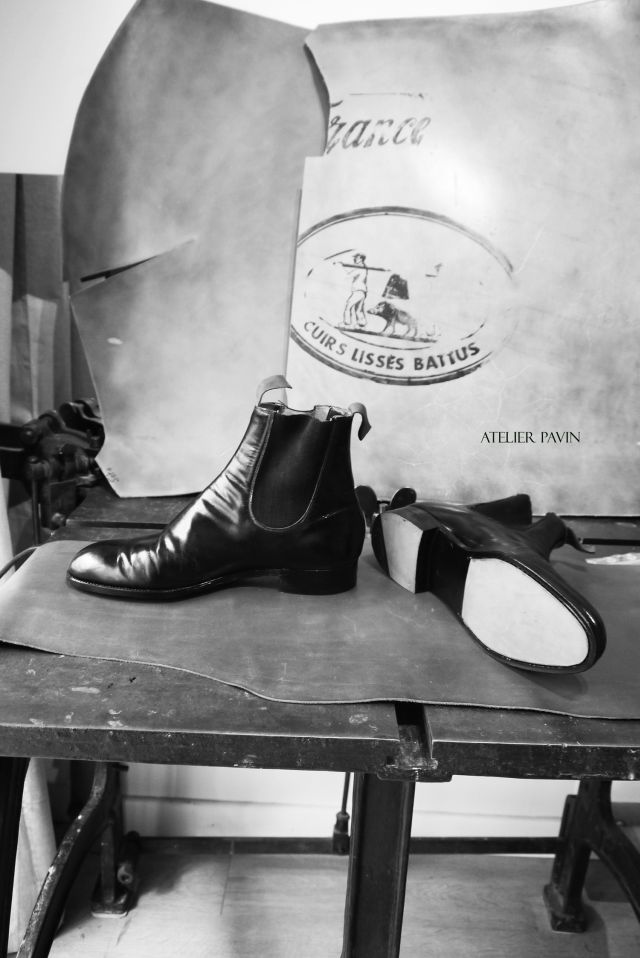
Please read the above well and read it again gentlemen, ladies, because verily the beautiful art of shoemaking dating back to the middle ages where shoes and boots were once made SUR MESURE for kings and knights, may very well be a slowly dying trade and going out of style and fashion in today’s mass-production global luxury consumer markets, where luxury goods companies and brandname ‘maisons’ are offering and bidding the highest for the last remaining know-how of the true designers and artisans of this ancient craft. For this must unquestionably also be how also Prada once began, how Blahnik or Roger Jourdan once earned their reputation, and how Louboutin still claims a name to fame (they recently opened a ‘faux’ small artisan workshop for their shoe repairs in Paris): The old-fashioned artisan workshop!
Thus the unfortunate truth is that the ferocious and insatiable global hipsters and luxury lovers market is slowly buying out the remaining Last of the Mohicans of independent shoe and boot design and that soon most if not all artisan shoemakers will be working for either Givenchy, Gucci, Christian Louboutin, or perhaps even for Tod’s (pun intended). Shoe makers and designers of the workshop caliber are normally the veteran players in the A leagues of shoe fashion and they usually belong to a well-known brand or house. But at Atelier Pavin it is not marketing and branding which sells a shoe, but the real quality delivered by fine and diligent craft- and workmanship; here your shoe or boot is made just for you and not for the purpose of luxury. Here your shoe has your name on it, and not the name of the brand or the house to which the shoes ‘belong’. A real shoe is still made and designed with patience and humility, as in times of old, and is not just another brand name product in the luxury market to be shown off at your latest fashion party when you are desperately trying to leave an impression being in the presence of so many ‘names’.
As a matter of fact, after having been initiated in the arts of shoemaking over the course of a long interview in French, we may report here that a ‘luxury’ market for shoes perhaps does not even exist. Because the art and craft of shoemaking and design is simply too complex and too labor-intensive for any brand or house to claim that one of ‘their’ pairs of shoes was made just for you, the highest a fashion house can reach for in terms of shoes and boots may be called ‘haut-de-gamme’ (high-end) and not ‘luxe-sur-mesure’.
There appears to exist a contradiction between a fashion house marketing their name attached to superior quality for the high-end shoe market using designs fit for haute couture, and the actual creative and labor-intensive process of shoemaking and design. There where style and form are unique, personal, and individual, branding has a tendency to become impossible. That this is different in case of shirts, ties, costumes, and coats tailored SUR MESURE, is because the creative process is less complex and less labor-intensive. A tailor/designer does not use ‘hundreds of tools’ in order to have a suit made. This privilege belongs to the shoemaker. Thus many ‘luxury’ handbags or suitcases for example can be made by a house of fashion, but shoes will always remain, well – perhaps because we walk on them –, very personal and unique!
The moral of the story is this: Let fashion house designers tailor and design new suits, new shirts, new clothes and let them do this with a cool & hip brand name and in the style of the ‘maison’ to which it is attached, and I will be happy. But whatever you do, when it comes to my shoes, and about who makes them, please don’t step on my Blue Suede Shoes! These, my shoes are too personal, too private – please don’t touch them! Because they were made in the old Faubourgs of Paris where the poor used to straddle the narrow streets next to the old markets, by a real shoe and bootmaker – a real Bottier from times of yore, at Atelier Pavin.
Posted by Sandro Joo